Teaching Philosophy
I teach sociology, which means I spend most of my time trying to get students to see the ordinary as strange. The baseline skill I’m after is critical analysis: the ability to look at something familiar and ask what’s actually going on beneath the surface. My courses are built around that goal. Students read theory, but the point is never the theory for its own sake. The point is learning to use it, which is why most of my courses culminate in a paper where students pick something from their own lives (a hobby, a community, a media object) and analyze it sociologically. The work that comes out of those assignments is consistently the strongest writing students produce all semester, because they’re finally doing the thing rather than reading about other people doing it.
Structurally, I design courses to be predictable so that the content can be demanding. Same module rhythm every week, same assignment logic, scaffolded checkpoints rather than high-stakes surprises. I came to this through experience, not theory: after teaching and TAing across more than a dozen courses, you start to notice that most of the friction in a classroom has nothing to do with the difficulty of the material and everything to do with students spending cognitive effort navigating the course itself. Remove that friction and they can actually think.
I also care about who’s in the room. As a first-generation college student, I didn’t always know the unwritten rules of how universities work, and I build my courses with that in mind. Rubrics distributed in advance. Workloads that are bounded and realistic. Multiple formats for demonstrating understanding. None of this is about lowering standards. It’s about making sure the standards measure what you actually want to measure.
Awards
(2024-2025) Center for Educational Innovation Thank-A-Teacher Award
(2018) Sociology Research Institute Instructor of the Year Runner-Up
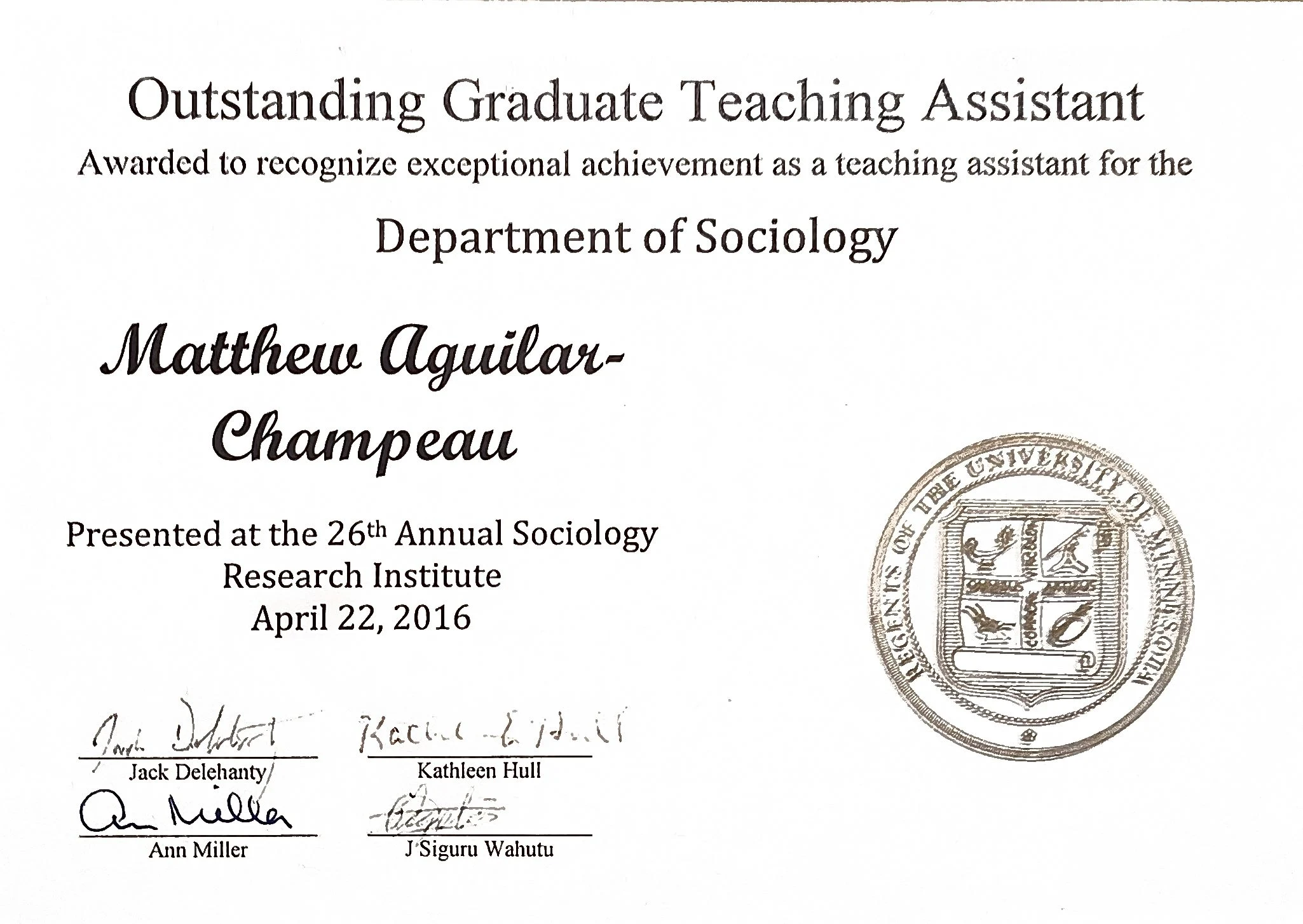
(2016) Sociology Research Institute Teaching Assistant of the Year
Testimonials
Student #1: “Matthew is really great at making subject matter easy to understand. He has a great sense of humor that makes him very relatable and approachable. His cynicism (although comedic) is a bit depressing.”
Student #2: “Analogies, diagrams, contemporary examples, consistent feedback to student comments. Personally, the unique appeal of this course is what helped me think (drawing of Dorito).”
Student #3: “He had a way of explaining class topics in a manor that most/ all students could absorb. He was always very respectful of others’ opinions and was willing to present helpful sociological insight when necessary.”
Student #4: “Matthew has been awesome. Truly one of my favorite teachers at the U. He engages with all students that choose to participate and makes sure the course is discussion heavy, which I think is always important, but especially for a class like this.”
Student #5: “Created space for very interesting and important discussions about issues that a lot of people don’t want to talk about regarding race/ class/ gender, but need to be talked about. He explained things very clearly in that he went straight to the point. His videos were incredibly helpful, especially for discussion.”
Student #6: “Matthew creates a very relaxed classroom environment which encourages but does not force participation. I think this is really successful. More people willing to contribute meaningful thought in this class than all other soc classes I have taken.”